ALL CHECKED BAGGAGE MUST HAVE OUTSIDE IDENTIFICATION!
TRANSPORTATION OF FIREARMS AND INSPECTION OF CHECKED BAGGAGE
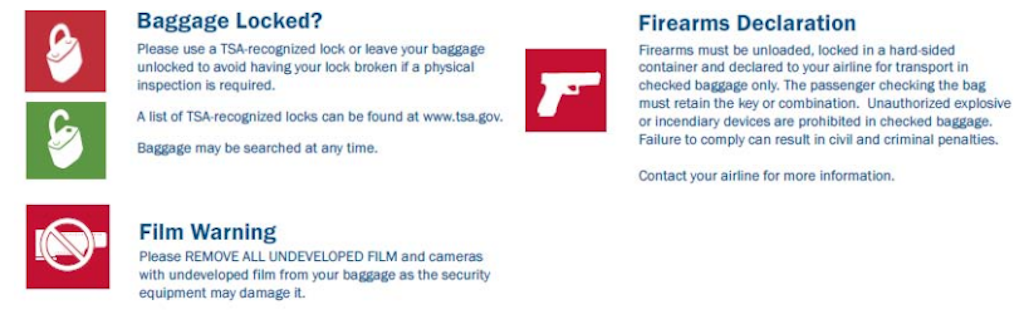
TSA REGULATIONS REQUIRE THAT FIREARMS IN CHECKED BAGGAGE MUST BE DECLARED, UNLOADED AND CARRIED IN A LOCKED HARD-SIDED CONTAINER. THE PASSENGER CHECKING THE BAG MUST RETAIN THE KEY OR COMBINATION. UNAUTHORIZED EXPLOSIVE OR INCENDIARY DEVICES ARE PROHIBITED IN CHECKED BAGGAGE. PASSENGERS FAILING TO DECLARE FIREARMS OR TRANSPORTING LOADED FIREARMS ARE SUBJECT TO SUBSTANTIAL CIVIL PENALTIES. PASSENGERS MUST CONTROL THEIR BAGGAGE TO PREVENT THE INTRODUCTION OF DANGEROUS ITEMS WITHOUT THEIR KNOWLEDGE AND MUST ALSO NOT ACCEPT ITEMS FROM UNKNOWN PERSONS. CARRY-ON ITEMS AND CHECKED BAGGAGE ARE SUBJECT TO SEARCH.
HAZARDOUS MATERIALS RESTRICTIONS
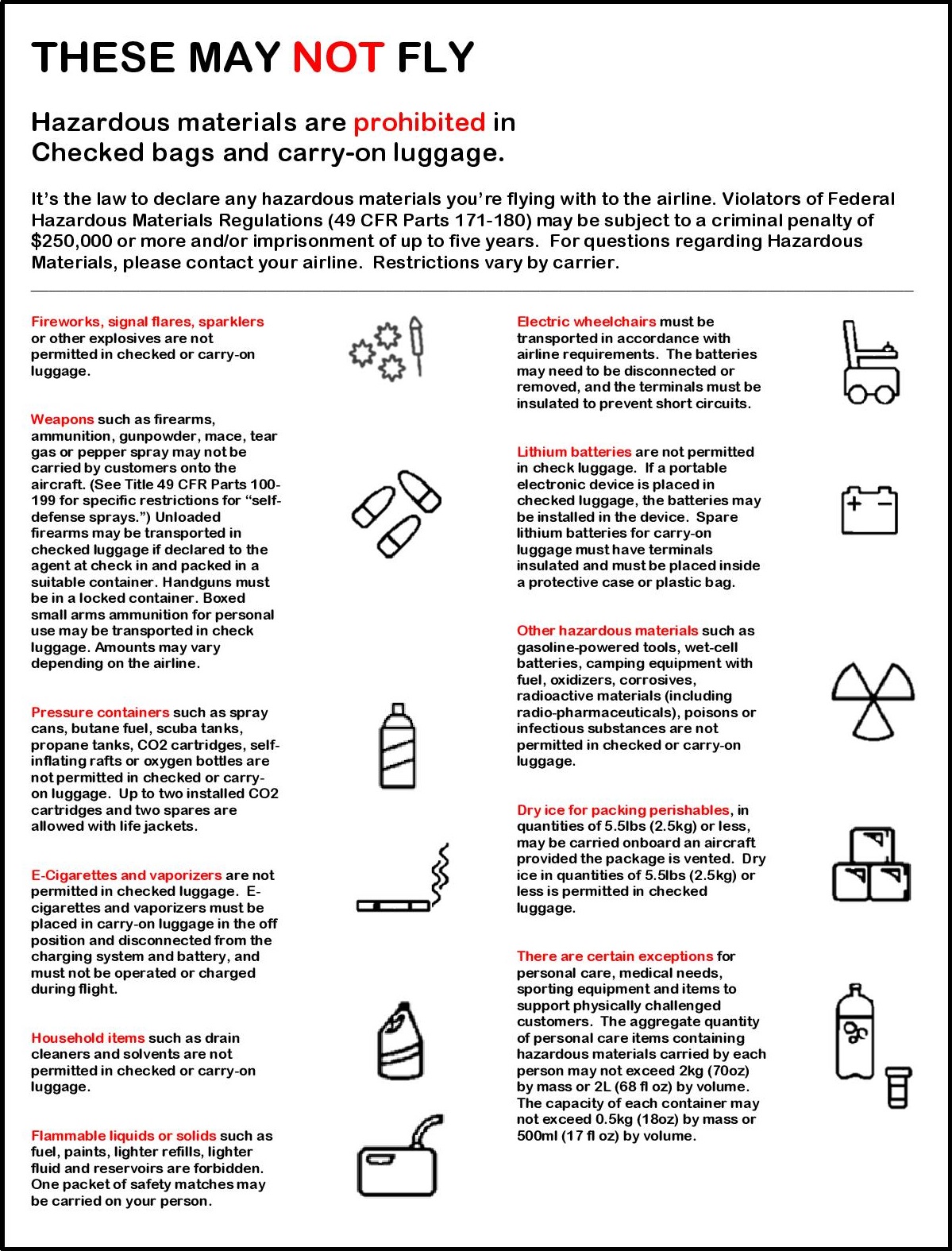
Federal law forbids the carriage of hazardous materials aboard aircraft in your luggage or on your person. Cargo containing hazardous materials (dangerous goods) for transportation by aircraft must be offered in accordance with the Federal Hazardous Materials Regulations (49 CFR parts 171-180). A violation can result in five years imprisonment and penalties of $250,000 or more (49 U.S.C. 5124). Hazardous materials (dangerous goods) include explosives, compressed gases, flammable liquids and solids, oxidizers, poisons, corrosives and radioactive materials. Examples: Paints, lighter fluid, fireworks, tear gases, oxygen bottles, and radiopharmaceuticals. There are special exceptions for small quantities (up to 70 ounces total) of medicinal and toilet articles carried in your luggage and certain smoking materials carried on your person. For further information contact your airline representative.
NOTICE-OVERBOOKING OF FLIGHTS
Airline flights may overbooked, and there is a slight chance that a seat will not be available on a flight for which a person has a confirmed reservation. If the flight is overbooked, no one will be denied a seat until airline personnel first ask for volunteers willing to give up their reservation in exchange for compensation of the airline’s choosing. If there are not enough volunteers, the airline will deny boarding to other persons in accordance with its particular boarding priority. With few exceptions, including failure to comply with the carrier’s checkin deadline (which are available upon request from the air carrier), persons denied boarding involuntarily are entitled to compensation. The complete rules for the payment of compensation and each airline’s boarding priorities are available at all airport ticket counters and boarding locations. Some airlines do not apply these consumer protections to travel from some foreign countries, although other consumer protections may be available. Check with your airline or your travel agent.
LIMITAIONS OF LIABILITY
Passengers on a journey involving an ultimate destination or a stop in a country other than the country of departure are advised that international treaties known as the Montreal Convention, or its predecessor, the Warsaw Convention including its amendments, may apply to the entire journey, including any portion thereof within a country. For such passengers, the treaty, including special contracts of carriage embodied in applicable tariffs, governs, and may limit the liability of the Carrier in respect of death or injury to passengers, and for destruction or loss of, or damage to, baggage, and for delay of passengers and baggage. For most international travel (including domestic portions of international journeys) liability for loss, delay or damage to baggage is limited to approximately $9.07 per pound ($20.00 per kilo) for checked baggage and $400 per passenger for unchecked baggage unless a higher value is declared and an extra charge is paid. Special rules may apply for valuables. Consult your carrier for details.
PUBLIC INSPECTION OF TARIFFS
- The Secretary of the Department of Homeland Security has determined that there is a high risk of terrorism against U.S. civil aviation. Additional restrictions are in effect to assure the security of air travel. To expedite the screening process, it is suggested that passengers travel light and accessible property should be organized and kept to a minimum.
- Passenger’s carry-on baggage should have minimal clutter to expedite the screening process.
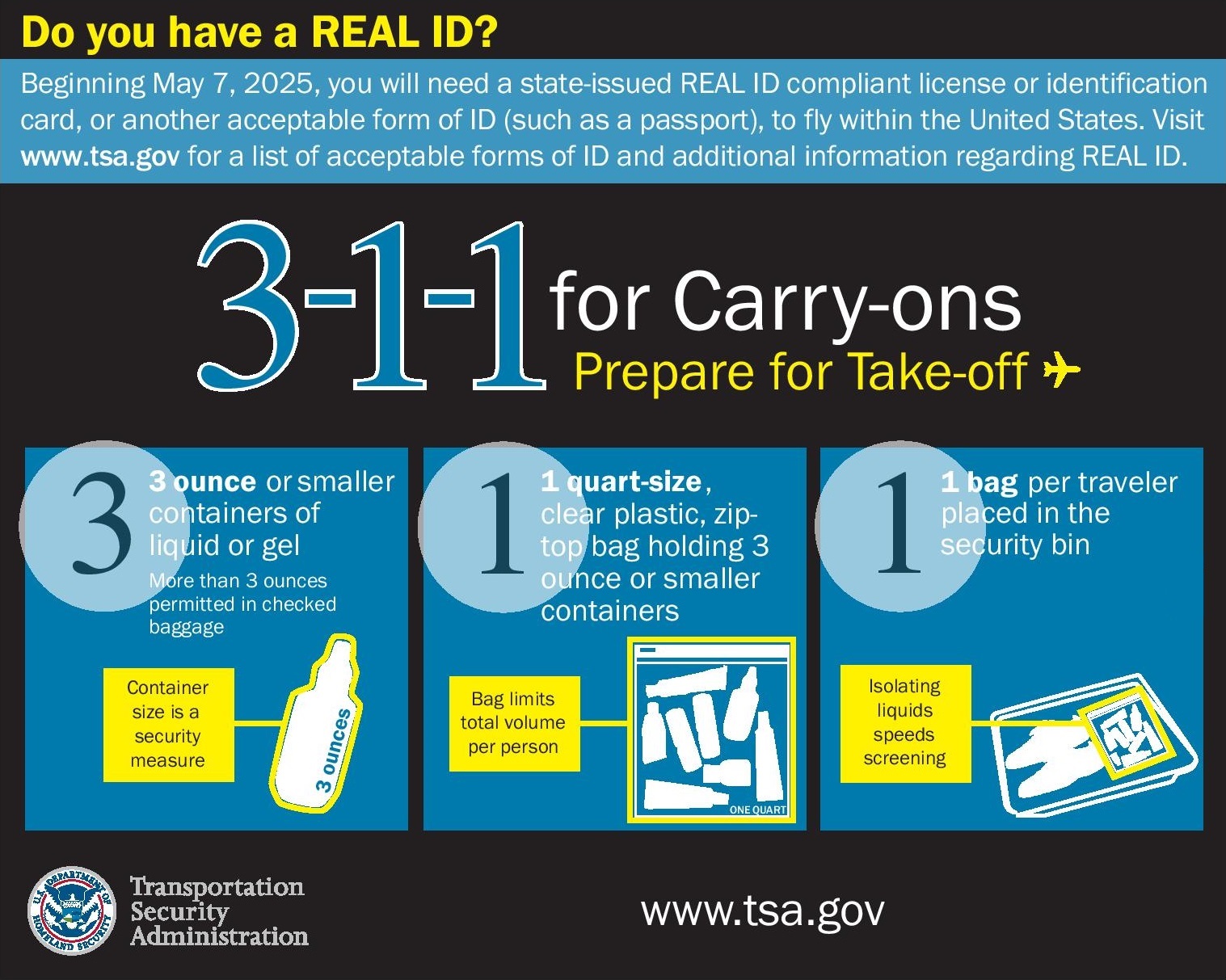
- Passengers are prohibited from taking liquids, gels, and/ or aerosols past the security check point EXCEPT for one clear transparent resalable 1 quart (1 liter) size plastic bag containing liquids, gels, and/or aerosols in travel size containers (3.4 oz./100 ml) capacity or less per container.
- The contents of the plastic bag must fit comfortably within the bag and the plastic bag must be completely closed/sealed.
- The plastic bag is subject to a visual inspection or x-ray screening (if available) seperate from passengers’ carry-on bag.
- If any of the below items do not fit in the closed/sealed 1 quart (1 liter) size plastic bag and/or the size of the containers exceeds travel size (3.4 oz./100 ml), they must be declared to screeners at the passenger screening checkpoint. Declaration must be made in conjunction with screening.
-
Upon declaration by the passenger, the aircraft operator
must determine if the types and quantities of the liquids, gels,
and/or aerosols fit within one of the following categories and
are in quantities reasonably necessary for the passenger's itenerary.
- Baby formula/milk (to include breast milk) and baby food/juice in containers if a baby or small child traveling
- Mications (liquid, gel, and/or aerosol)
- Liquids (to include juice) or gels for diabetic or other medical needs
Passengers may be subjected to secondary screening if they enter the screening checkpoint with liquids, gels, and/or aerosols on thier person or in their carry-on baggage.